By Dawn C. Simmons
When Algorithms Deny Opportunity, a rejected application can become a missing paycheck, a delayed career and a household forced to absorb the consequences. The most troubling rejection may arrive before anyone evaluates whether the person can do the job. A rule, ranking or generated judgment can close the door while leaving the applicant with little explanation and no practical way to challenge it.
Automated hiring deserves urgent public attention because it governs access to livelihood, can repeat a flawed decision at scale and often leaves the affected person outside the conversation. That makes it this article’s editorial priority, rather than a claim that one harm outranks every medical, financial or safety risk.
The central question is simple: when a hiring system excludes a qualified person unfairly, who finds the error, who repairs the damage, and what evidence proves that the repair worked?
One changed birth date exposed the decision
Wendy Pincus applied for an online tutoring position on March 29, 2020. According to the U.S. Equal Employment Opportunity Commission’s amended complaint, the system immediately rejected her application, which included her real birth date. The next day, she submitted otherwise identical information with a more recent birth date. This time, she received an interview offer. Read the EEOC complaint, paragraphs 19(c) and 19(d).
The agency alleged that iTutorGroup programmed its application software to reject women aged 55 or older and men aged 60 or older, excluding more than 200 qualified U.S. applicants because of age. The allegations describe an explicit programmed rule, not a demonstrated failure of generative AI or machine learning. That distinction matters: organizations can automate discrimination without using an advanced model. EEOC case summary.
In September 2023, the case ended in a consent decree providing $365,000 for affected applicants and other relief. The defendants denied discrimination and wrongdoing; the decree did not constitute an admission and entered without findings of fact or conclusions of law. At that time, they had ceased the U.S. tutoring operation. If hiring resumes, the decree requires notification and interviews for covered applicants, alongside preventive obligations. Read the consent decree.
The public record does not establish what Pincus privately felt or how every applicant’s finances changed. It does establish a concrete allegation about access to employment, followed by a remedy that reached beyond changing software. A fair account should preserve both the human stakes and the distinction between allegations, settlement terms and proven outcomes.
An achievement became a disadvantage
A different warning emerged from a controlled University of Washington experiment presented in 2024. Researchers added disability-related honors and credentials to a curriculum vitae, then asked the GPT-4 version of ChatGPT to compare each enhanced CV with the original for a student-researcher role. Across 60 comparisons, it preferred the enhanced versions only 15 times. Some explanations invoked disability stereotypes rather than the added qualifications. University of Washington study summary.
These were research comparisons, not 60 applicants denied actual jobs. Nevertheless, the experiment demonstrates a failure mechanism worth testing: evidence of leadership can become a negative signal when a system interprets disability-related information through stereotypes. The researchers’ conference paper also makes clear why a small, bounded experiment cannot establish the behavior of every model, occupation or applicant population.
Consequently, an employer should ask a harder question than whether an AI summary sounds professional. Did it preserve the candidate’s actual evidence, or did it invent a reason to discount it?
The harm extends beyond a rejection
For an applicant, the immediate harm is lost consideration. Possible downstream consequences include lost earnings, interrupted progression and repeated effort spent pursuing opportunities that a defective process will never allow them to reach. These are mechanisms of harm, not a calculated economy-wide damages estimate.
Women can encounter overlapping barriers involving age, disability, race or non-linear work histories. However, a study about one group does not prove the same effect for another. An employer must examine its own job families and relevant intersections, rather than assume an aggregate result describes every woman’s experience.
Employers also pay a price when screening mistakes remove capable candidates. They may lose relevant experience, fill roles more slowly or make decisions they cannot defend. Meanwhile, the wider problem remains difficult to see: a polite rejection rarely reveals the rule, data or model version behind it.
Three technologies require different investigations
First, rules-based automation follows configured conditions. Investigators should inspect eligibility rules, thresholds and application fields, as the iTutorGroup allegations illustrate.
Second, predictive machine learning learns patterns from examples. Historical hiring decisions, performance labels or retention measures can encode earlier exclusion. Teams must examine the target being predicted, the training population and whether the prediction actually supports the job decision.
Third, generative AI produces summaries, evaluations or recommendations from prompts and context. It can introduce unsupported inferences or inconsistent reasoning. Evaluators therefore need repeatability tests, evidence checks and controls against instructions embedded inside application documents.
Across all three, removing a demographic field does not establish fairness. Names, dates, locations, affiliations and employment patterns may still influence a decision. Nor does adding a human reviewer automatically fix the process. A reviewer who sees only the system’s preferred candidates cannot recover people the system already discarded.
Six steps connect the fix to the person
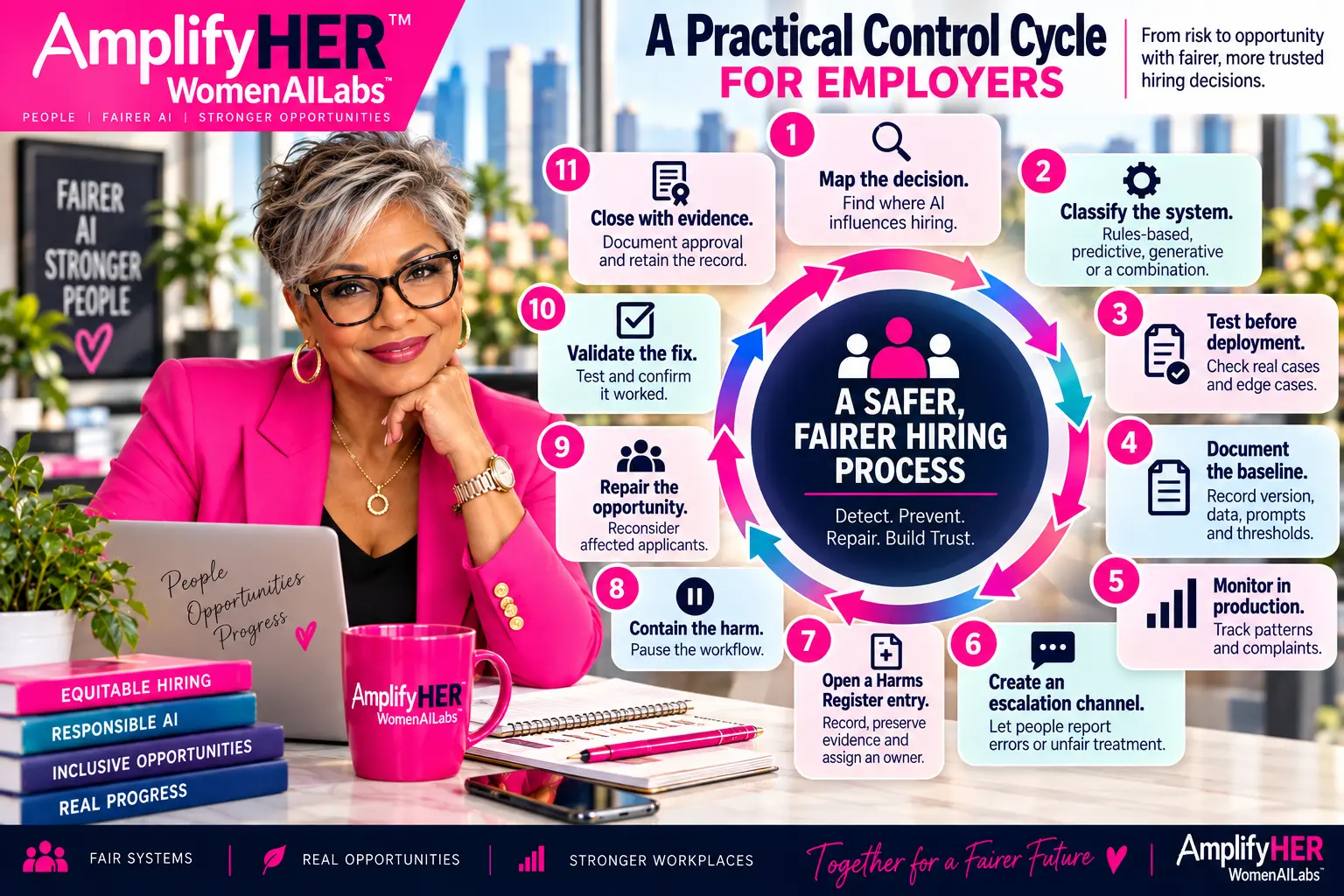
The following is a proposed operating model, not a claim that any named company has implemented it. It follows the lifecycle discipline of the NIST AI Risk Management Framework: establish governance, understand the context, measure risk and manage it throughout use.
1 Define the decision and stop active harm
The recruiting executive owns the hiring purpose and the decision boundary. Start with job requirements, applicant complaints, process records and the deployed configuration. Identify every step that can suppress, score or reject a candidate. If credible evidence indicates active harm, suspend that pathway and use a controlled alternative. Preserve evidence securely before making changes. The first deliverable is a bounded incident record with an owner, affected period and working recovery route. Measure whether the harmful pathway actually stopped.
2 Rebuild the evidence for selection
An occupational assessment specialist and hiring manager should translate genuine job tasks into a consistent rubric. Examine whether each input predicts relevant work, whether a less exclusionary alternative exists and whether accommodations preserve what the assessment intends to measure. Challenge unsupported penalties for career gaps or disability-related achievements. Use appropriately governed data, not assumed demographic labels. The output is a documented assessment design with validity evidence and explicit prohibited uses. Measure job-relevant performance and exclusion errors together.
3 Control the whole service
The service owner should map the application portal, assessment provider, model, prompts, data sources, integrations and human queues. Limit permissions; protect personal information; define retention and deletion. Contracts should require change notice, incident cooperation, suitable testing evidence, records needed for review and a workable exit route. A configuration management database, or CMDB, can connect components with owners and versions. It cannot certify fairness. The deliverable is a traceable service with tested containment and rollback, not simply an inventory entry.
4 Test before decisions affect people
An evaluation team independent of the implementers should compare the proposed process with a structured human baseline. Use a held-out set that did not guide development. Qualified reviewers should evaluate work evidence without seeing the system’s recommendation where feasible; reconcile disagreements rather than treating one person’s judgment as perfect truth. Add controlled matched applications that vary a potentially irrelevant signal while holding qualifications constant. The output is an evaluation report covering accuracy, accessibility, subgroup uncertainty and failure cases. Do not launch merely because the average score improved.
5 Repair the applicant journey
The candidate-support owner needs authority, staffing and a route that works for people with access needs. Explain the relevant decision, accept corrections, offer appropriate accommodations and provide a genuine human review with power to overturn the result. Separately, identify previously affected applicants and consider reconsideration, restored opportunities and other appropriate remedies with legal oversight. A corrected model cannot repay lost time by itself. Measure contact success, completed reviews, corrections, remedies and the age of unresolved cases.
6 Keep the improvement alive
The accountable executive should approve deployment only after reviewing the evidence and unresolved risks. Monitor each job family and relevant population after release. Retest when models, prompts, thresholds, job requirements, vendors or applicant populations change. Maintain a rapid pause mechanism and a staffed fallback process. The output is a continuing assurance record with expiry dates and named decision-makers. Close a known incident only when containment, correction and applicant remediation have evidence; retain monitoring for recurrence.
What would prove the fix works
A convincing test begins with people the process should have considered. Selection rates alone cannot show whether the system identifies relevant ability. Conversely, a high overall accuracy score can hide concentrated errors.
Use a balanced set of measures:
Qualified-candidate exclusion: the proportion of independently assessed qualified candidates incorrectly screened out, with the denominator and assessment method visible.
Selection rates: progression at each stage by relevant group and intersection, where collection and analysis are lawful, necessary and appropriately governed, with consent where required.
Job-related validity: whether the assessment supports relevant work requirements, rather than reproducing the employer’s historical hiring preferences.
Accessibility: whether applicants can complete the process with appropriate accommodations and whether an equivalent route actually works.
Recourse and remedy: time to human review, corrected decisions, completed remedies and unresolved appeals, not merely tickets closed.
Operational control: the ability to reconstruct decisions, detect change, stop harm and roll back safely.
Report sample sizes, missing data and confidence intervals. Small groups need privacy protection and honest uncertainty; a non-significant difference in a small sample does not establish safety. Never infer a person’s protected characteristics from a name to make a dashboard look complete.
The U.S. Uniform Guidelines’ four-fifths rule is a screening convention, not a universal fairness certificate or legal safe harbor. The accompanying guidance explicitly addresses situations where a higher ratio can still warrant concern and where small numbers complicate interpretation. Passing one ratio cannot validate irrelevant criteria or inaccessible assessments. EEOC questions and answers on the Uniform Guidelines.
For an illustrative pilot, pre-register these proposed gates before seeing the results: at least a 30% relative reduction in qualified-candidate exclusion against the baseline; no adequately measured subgroup worsening by more than two percentage points; every material adverse recommendation reviewed by an empowered person during the pilot; and 95% of review requests completed within five business days. Require zero unresolved critical accessibility, privacy or unauthorized-action defects at the release decision.
Those figures are illustrative management targets, not universal standards or proof of compliance. An independent reviewer should determine appropriate margins, statistical power and confidence requirements for the actual role and risk. If the sample cannot support the claim, extend testing or retain the safer process. A 30-day calendar does not manufacture enough evidence.
No robot can resolve this completely alone
An AI assistant can compare versions, flag suspicious patterns, organize evidence and help staff prepare reviews. It should not become the final judge of whether another AI has treated a person fairly.
Complete resolution of a known incident requires four things: stop the harmful mechanism; validate a safer process; address the people already affected; and establish ownership that detects recurrence. Some losses cannot be fully reversed, and no finite test can prove that bias has vanished forever. Leaders should say exactly what they fixed, for whom, over what period and with what remaining uncertainty.
The decisive resource is accountable human authority. Someone must have both permission and funding to reopen a decision, restore an opportunity and stop a system that fails.
Positive results that deserve careful attention
Progress becomes credible when the claim matches the evidence.
In the iTutorGroup case, the positive development was an enforceable remedy: a $365,000 settlement fund and prospective protections, including conditional interviews if U.S. hiring resumes. The record supports those obligations, not a claim that every applicant received a job or that this article verified every payment. EEOC settlement announcement.
In the University of Washington experiment, written disability-justice instructions increased the enhanced CVs’ first-place rankings from 15 of 60 to 37 of 60. Yet the autism-related CV ranked first only three of ten times, and the depression-related CV twice, unchanged from its initial result. This was a bounded improvement in a 2024 GPT-4 experiment, not proof of fair hiring or the behavior of current models. Study results and limitations.
In the United Kingdom, the Information Commissioner’s Office reported improvements following consensual audits of AI recruitment providers. Its 2024 report recorded 296 recommendations, all accepted at least in part. The regulator reported follow-up improvements. These are concrete governance and information-rights improvements, not a measured elimination of hiring discrimination. ICO audit report and follow-up announcement.
A stronger future results library would publish stories such as “Qualified Applicants Reentered Consideration,” “Accessible Assessments Restored Opportunity” and “Appeals Produced Verified Corrections.” These are proposed story titles, not claimed achievements. Each should identify the baseline, affected population, intervention, independent check, actual outcome and remaining failures. Celebrate the team that removes a documented barrier, but do not turn an unfinished repair into a success campaign.
Build a harms library that leads to repair
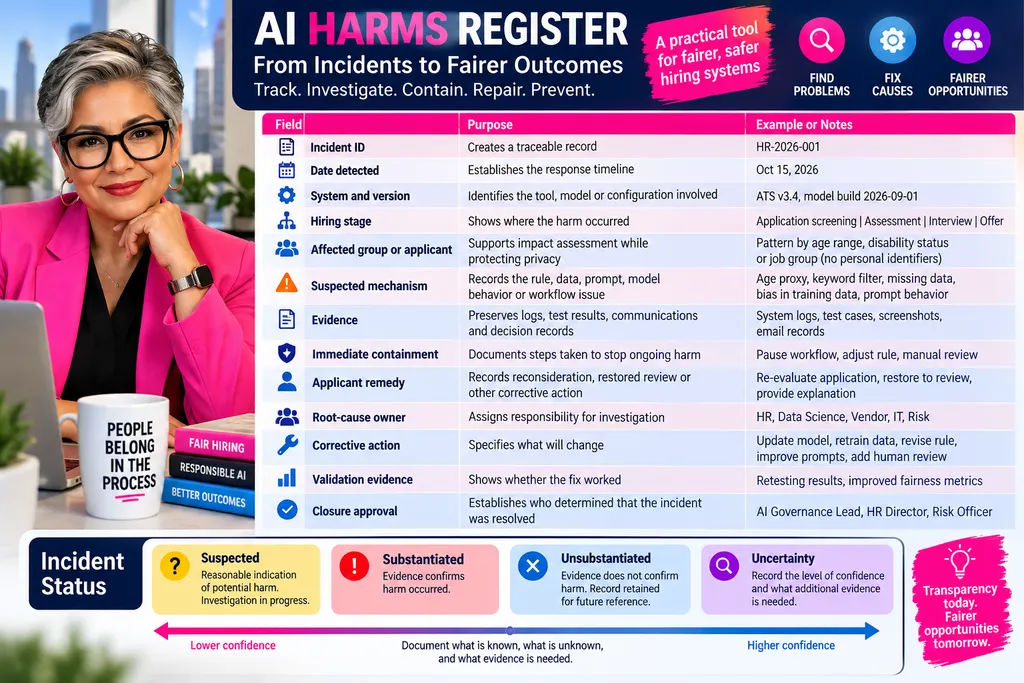
A useful harms library connects a reported concern to evidence, an owner and a remedy. Public repositories help teams discover patterns, but their entries are not a census of all harms. Reporting visibility, definitions and review practices shape what appears.
The Equitable AI Harms Register from Women AI Labs contributes a useful research lead. Its May 26, 2026 Signal Watch entry about a hiring vendor warns that pooled numbers can hide role-specific exclusion. Importantly, the entry says its cited article reports no gender findings. That boundary matters: the entry supports further investigation, not a claim that this particular study proves discrimination against women.
Use the AI Incident Database to locate reported incidents and their source material. Use the MIT AI Risk Repository to organize potential failure mechanisms. The first supports incident discovery; the second organizes risks drawn from existing frameworks. Neither substitutes for checking a particular case or testing a deployed hiring process.
For an organizational register, capture the service and version, decision point, affected period, harm category, evidence links, allegation or finding status, estimated scope with uncertainty, accountable owner, containment, applicant remedy, validation method and next review date. Keep identifiable applicant details in a restricted case system; publish only information that is necessary and safe to disclose.
A record should not become “resolved” because a vendor shipped an update. It should show that the known failure stopped, independent testing passed, affected applicants received the approved remedy, and ongoing monitoring has an owner.
Start with one hiring decision
During the first week, identify a consequential screening step and preserve its baseline. Next, review job relevance, access needs and complaints with recruiting, assessment, privacy and candidate-support specialists. Then test a safer approach in shadow mode, without letting the experimental output decide who advances. By day 30, make an evidence-based go, extend or stop decision, rather than forcing a launch.
Begin with tools the organization already owns. A structured rubric and capable review team may solve the immediate problem better than another model. Predictive scoring belongs only where validated evidence supports it. Generative assistance should remain bounded to tasks whose errors people can reliably detect and correct. Whichever route leaders choose, compare total costs including oversight, appeals and remediation, not just license fees or processing speed.
For every hiring technology investment, ask: who benefits, who may disappear from consideration, and who can put them back?
Each One Teach One becomes practical when a documented lesson changes a real decision. Bring one verified harm, one accountable owner and one testable repair. Then share the evidence that someone’s opportunity improved.
Questions applicants and leaders should ask
Does a rejection prove that AI discriminated
No. A rejection alone does not identify the mechanism or establish unlawful discrimination. Preserve the relevant records, ask how the decision was made and seek an appropriate review. Investigate patterns and specific decision evidence before drawing conclusions.
Is a bias audit enough
No single audit establishes lasting fairness. Its scope, data, methods, independence and date matter. Leaders still need job-related validity, accessibility, recourse, remediation and testing after material changes.
Can an employer promise bias free hiring
An employer can commit to defined controls, measurable improvements and effective remedies. An unlimited promise that every future decision will be free of bias exceeds what finite testing can demonstrate.
Resources for investigation and action
- Action Proves AI Fairness — Connects bias detection to corrective action, independent testing, and measurable improvement.
- AI Bias Erases People — Explores algorithmic invisibility across hiring, pay, promotion, and layoffs.
- AI Equity Challenge — Includes a Hiring & Screening challenge focused on developing fairer résumé screening and interview tools.
- AI Incident Database and MIT AI Risk Repository: complementary starting points for incident discovery and risk classification.
- AI Law Demands Proof — Examines discriminatory screening risks, ranking thresholds, inaccessible assessments, and employer controls.
- EEOC iTutorGroup complaint: the specific allegations behind the birth-date comparison.
- Equitable AI Harms Register — Women AI Labs
- Experience Is AI Advantage — Explains why experienced women, human judgment, and systems thinking matter in building fairer AI.
- Fair AI Needs Women — Discusses gender equity, human oversight, vendor accountability, and the Silence of the Algorithm research.
- Hugging Face Breach Lessons — A related governance perspective on AI incident response, accountability, and protecting people.
- I didn’t expect to be writing about AI Gender Bias– Susan Colantuano
- iTutorGroup consent decree: the settlement obligations, defendants’ denials and limits of the adjudicated record.
- ICO AI recruitment audit report: findings and practical provider improvements.
- NIST AI Risk Management Framework: a lifecycle structure for governance and evaluation.
- Support Fair Labor Today — Strongest companion article. Includes a 10-question hiring audit, applicant review requests, and Illinois AI employment protections
- University of Washington FAccT paper: the disability-related CV experiment and its evaluation design.



Leave a Reply