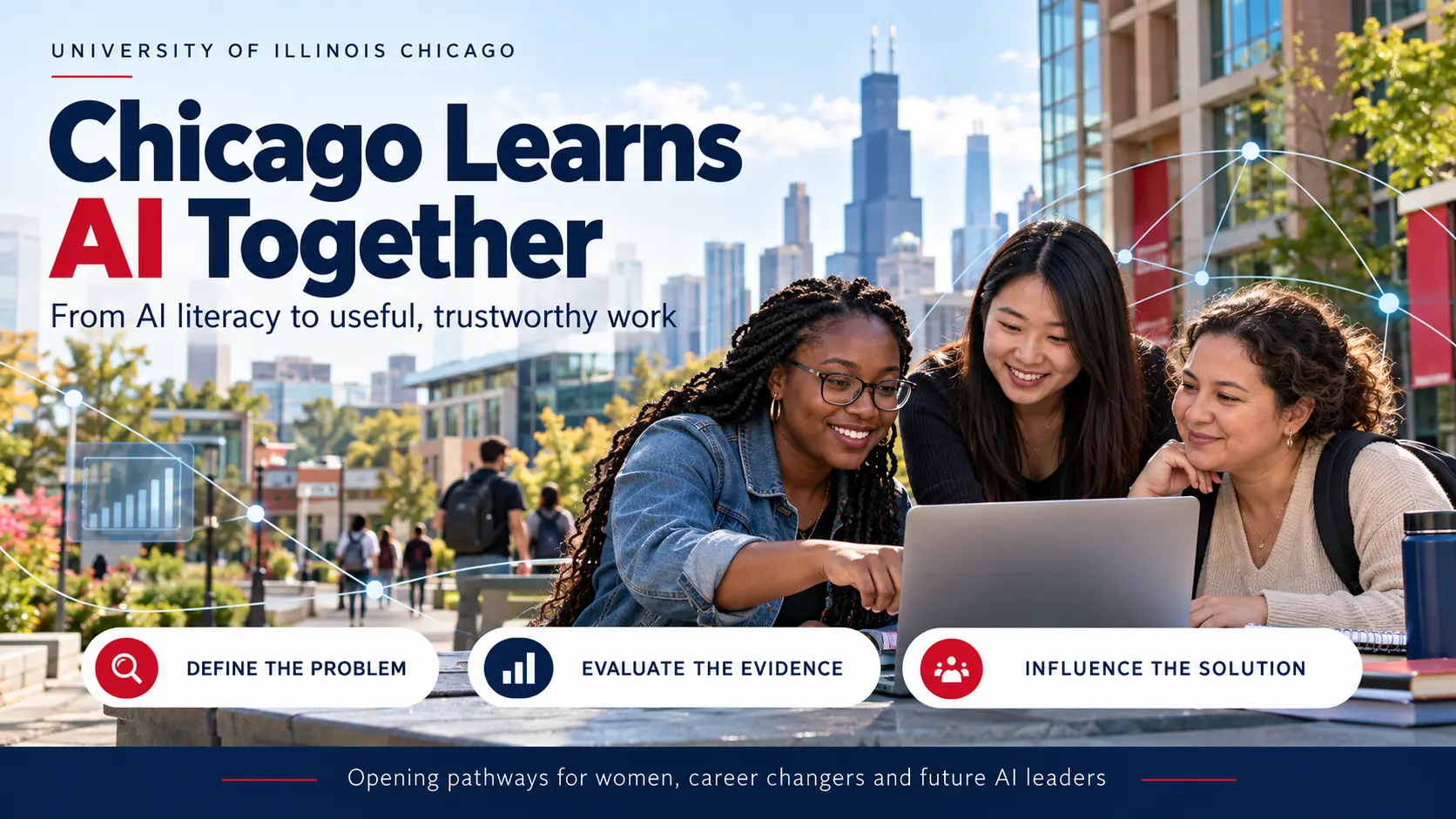
Chicago Campuses Reframe AI expanding AI pathways connect classroom learning with industry challenges—and create an opportunity to give more women meaningful roles in building, testing and leading AI.
AmplifyHER Editorial Desk | Editorial review October 21, 2026
Chicago campus AI education is expanding as employers seek people who can turn powerful technology into useful, trustworthy work. From introductory literacy at the University of Illinois Chicago to advanced graduate study at the University of Chicago, new pathways invite students to connect technical knowledge with practical problems.
However, the most consequential question goes beyond which course teaches the newest tools: Who will learn to define the problem, evaluate the evidence and influence the solution?
For women, students changing disciplines and experienced professionals entering AI, that question connects education with opportunity.
Why AI education matters now
AI adoption has accelerated. Stanford’s 2025 AI Index reported that 78% of survey respondents said their organizations used AI in 2024, compared with 55% in 2023—a 23-percentage-point increase. These survey findings describe growing organizational use, rather than a census of every business. Explore Stanford’s AI Index. hai.stanford.edu
Meanwhile, federal projections show substantial demand in a related occupation. The U.S. Bureau of Labor Statistics projects 35% growth in data scientist employment between 2025 and 2035, with approximately 24,800 openings annually, including replacement openings. BLS also reports a $120,230 national median annual wage in May 2025. These figures cover data scientists across experience levels; they do not promise graduate starting salaries or describe every AI career. Review the BLS outlook. bls.gov
Together, these indicators strengthen the case for education that combines technical capability, domain knowledge and sound judgment. Consequently, students need experience testing accuracy, explaining limitations and deciding when a human should intervene.
Why Chicago?
Chicago connects AI education with industries that face consequential, practical problems: healthcare, finance, manufacturing, logistics and professional services.
World Business Chicago’s 2025 analysis estimated Chicagoland’s broadly defined AI economy at $57.4 billion in gross regional product and more than 164,000 jobs. Its definition includes core infrastructure, enabling industries and AI delivery, so those positions are not all AI engineering jobs.
Furthermore, the agency reported that 306 regional AI and machine-learning companies raised $10.6 billion through 723 growth-capital deals since 2019, as of that analysis. Read the regional analysis and methodology. worldbusinesschicago.com
The educational implication is compelling: Chicago offers a setting where students can connect computing with established fields of expertise. A healthcare application needs clinical context. A manufacturing model needs operational knowledge. A public-service tool needs accessibility, accountability and a clear understanding of whom it serves.
Therefore, Chicago’s opportunity lies in connecting people who understand technology with people who understand the work.
Different starting points, meaningful pathways
UIC opens the conversation beyond computer science. Its April 2026 announcement described an AI Literacy course for students outside the discipline, alongside programming pathways and deeper AI options for computing majors.
The university also reported more than 25 AI-specialized computer science faculty and a five-year curriculum redesign supported by a $1 million National Science Foundation grant. Meanwhile, its existing Data + AI sequence connected interdisciplinary student teams with industry partners. Explore UIC’s curriculum initiatives. UIC today
UChicago targets students with stronger technical foundations. Announced September 17, 2026, its nine-month, full-time, in-person MS in Applied Artificial Intelligence welcomes its first cohort in autumn 2027 at the university’s downtown campus. The curriculum combines advanced AI with security, safety, governance and value creation. Read UChicago’s announcement. University of Chicago News
These pathways serve different learners. Accordingly, compare prerequisites, total cost, scheduling, mentoring and project ownership before applying. Announced curricula establish educational plans; graduate employment and equity outcomes require subsequent evidence.
PalmWatch turns learning into a deliverable
UChicago’s PalmWatch partnership with Inclusive Development International shows how applied learning can address a public-interest information need.
The Data Science Institute developed scripts to clean and standardize public palm-oil information and estimate associated deforestation. It then organized the findings into a tool that supports exploration across mills, companies, brands and countries. Read the development account. DSI
Next, a student Clinic team added a feature to identify and classify human-rights violations, according to the institute’s 2025 project review. That account documents a software contribution; it does not establish how many violations the tool prevented. Explore the completed Clinic projects. DSI
The repeatable lesson is practical: work with a knowledgeable partner, define the information need, build a useful deliverable and test its performance before claiming broader impact.
Give women responsibility and visibility
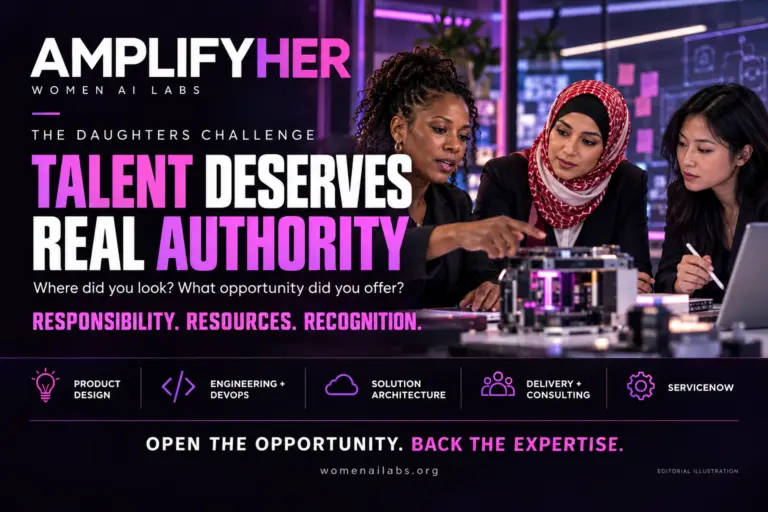
A great story about Addison Carriere a student athlete and engineer. As AI learning expands, universities and employers should examine who receives funded research, mentoring, employer introductions and technical leadership assignments.
For women entering the field, meaningful participation includes opportunities to shape requirements, challenge assumptions, design evaluations and present results. Therefore, institutions should track access to those responsibilities alongside enrollment and completion.
A proposed 30-day campus challenge could make that commitment concrete. A faculty adviser or student-program lead would recruit an interdisciplinary team, select one public-data problem and assign named responsibilities for research, engineering, testing and communication. By day 30, the team would publish its baseline, results, failures, accessibility findings and maintenance plan.
Success would mean a reviewable contribution—and clear evidence of who gained an opportunity to lead.
People worth learning from
- Shanon Reckinger, UIC: Explore her work on computing education, undergraduate experience and broadening participation, Department of Computer Science. University of Illinois Chicago
- Susan Paykin, UChicago DSI: Learn from her community-centered data science institutional work connecting technical teams with public-interest partners. DSI
- Arnab Bose, UChicago: Examine the applied AI curriculum he directs, which connects advanced systems, practical applications and governance. University of Chicago News
Finally, take one practical step: compare two learning routes and identify the work each would help you produce. UChicago currently lists application deadlines of November 9 and December 7, 2026, followed by January 26, 2027. Check current deadlines and events. DSI
Chicago can grow AI talent by giving more people meaningful problems to solve—and a fair opportunity to lead the solution.




Leave a Reply