
The cancellation of the 2026 Grace Hopper Celebration raises an uncomfortable question about who the technology industry considers worth investing in.
Black women have been telling y’all.
We’ve been telling you about the closed doors, the disappearing opportunities, the rooms where we’re invited to contribute but rarely empowered to make decisions. We’ve been telling you what it feels like to be celebrated for our resilience while being denied the resources that would make resilience less necessary.
And now the 2026 Grace Hopper Celebration, one of the world’s largest gatherings of women in technology, has been canceled.
According to AnitaB.org, the organization behind the conference, registrations and sponsorship commitments fell significantly below expectations and the levels needed to cover critical operating expenses.
Let that sit for a moment.
At a time when artificial intelligence is attracting enormous attention, investment, and corporate ambition, one of the industry’s most recognizable spaces dedicated to women couldn’t secure enough financial support to proceed.
So I have a question: Does the technology industry actually value women, or does it just enjoy being seen supporting us?
Black women have been having this conversation
For Black women in technology, conversations about access, sponsorship, visibility, and opportunity aren’t new.
We’ve watched diversity initiatives become marketing campaigns. We’ve seen organizations celebrate women’s achievements while overlooking the people doing the work. We’ve been asked to mentor, volunteer, organize, educate, and build community, often with little financial investment in the labor required.
And we’ve learned that being invited into the room doesn’t necessarily mean being included in the budget.
I work at the intersection of AI education, digital strategy, and community building. I’ve seen what happens when people are given genuine access to tools, knowledge, relationships, and opportunities. I’ve also seen how much of that access depends on individuals willing to create something where institutional support is missing.
Communities don’t build themselves.
Workshops don’t facilitate themselves.
Mentorship doesn’t happen because somebody added an inspirational quote to a corporate LinkedIn post.
Someone is doing that work. And too often, women, particularly Black women, are expected to do it for the love of community.
Love doesn’t pay the venue deposit.
The funding gap doesn’t begin at Grace Hopper
Here’s another uncomfortable part of this conversation: Black women-led organizations and businesses are often expected to prove their value long before anyone is willing to invest in their potential.
We are asked for attendance numbers, testimonials, impact reports, conversion metrics, and evidence of sustainability. We are expected to demonstrate that our communities are engaged, our programming is effective, and our audiences are worth reaching.
Meanwhile, we’re often doing the work with personal savings, donated space, borrowed equipment, volunteer labor, and whatever technology we can afford.
And when we finally demonstrate traction, the conversation shifts. Now we need to prove we can scale.
At what point does the investment arrive?
The disparity isn’t just anecdotal.
According to a May 2026 Crunchbase analysis, startups with at least one Black founder received approximately $942 million in venture funding in 2025, representing just 0.32% of total U.S. venture funding.
That statistic covers Black-founded startups broadly, not Black women specifically. But it illustrates how little capital reaches an already underfunded part of the entrepreneurial ecosystem.
And although venture capital and corporate conference sponsorship are different funding mechanisms, both raise questions about who gets access to resources, relationships, and institutional confidence.
I’ve spent this year helping people build with AI, teaching emerging technologies, and creating spaces where founders and curious learners can experiment without feeling intimidated or excluded.
Through Build in Beta and my work with community partners, including The Gathering Spot and Zo Computer, I’ve seen what happens when people are given access to knowledge and relationships.
But I also understand the invisible labor behind making those opportunities possible.
The planning. The outreach. The teaching. The follow-up. The emotional labor of encouraging someone who has been told, directly or indirectly, that technology isn’t for them.
We shouldn’t have to exhaust ourselves proving that our communities deserve investment.
And that’s why the Grace Hopper cancellation matters beyond the loss of one conference.
If an established, internationally recognized gathering for women in technology cannot secure enough financial commitments to operate, imagine what that signals to smaller, women-led organizations already struggling to get sponsors to return an email.
Imagine what it means for the Black woman building an AI education program in her community, the founder creating accessible technology for underserved populations, or the independent educator teaching people how to participate in an economy that’s changing faster than most institutions can respond.
These women are doing workforce development. They’re building talent pipelines. They’re expanding access to technology.
And too often, they’re financing that work with their own capacity.
The industry cannot keep celebrating the pipeline while refusing to pay the people building it.
A sponsorship is a statement of priorities
Let’s be careful about what this cancellation does and doesn’t tell us.
We don’t yet know all the factors behind the funding shortfall. Economic pressures, changing conference strategies, event costs, and organizational challenges may all have contributed.
What we do know, according to AnitaB.org, is that registrations and sponsorship commitments came in significantly below expectations and below the amount needed to cover operating expenses.
That is the documented financial reality. It does not establish that individual sponsors deliberately withdrew support or explain why particular companies made their decisions.
But the collective funding shortfall deserves scrutiny.
When corporations announce their commitment to developing women in technology, what does that commitment look like beyond a press release?
Are they funding technical education? Are they paying women to teach? Are they sponsoring emerging leaders who don’t already have access to elite networks? Are they investing in the community organizations building tomorrow’s workforce?
Or is support conditional on the marketing value of being associated with an initiative?
Because there is a difference between wanting women represented in your company photograph and investing in their ability to shape the company itself.
A corporate sponsorship isn’t charity. It’s a decision about where an organization believes value exists.
And while no single company is obligated to fund a particular conference, the collective funding shortfall should prompt us to examine what the industry prioritizes.
Representation without resources is a photograph. Investment is what makes participation sustainable.
AI makes this even more urgent
We are living through a defining moment in technology.
AI is changing how we work, create, learn, hire, and make decisions. The people shaping these systems are making choices that will influence millions of lives.
Yet women remain underrepresented in computing and AI development.
According to the U.S. Bureau of Labor Statistics, women represented just 26.0% of full-time wage and salary workers in computer and mathematical occupations in 2024, compared with 74.0% men.
That is not a small participation gap.
And as Sandy Carter discusses in her October 13 Forbes article on the Grace Hopper cancellation, the stakes are particularly significant as AI transforms the technology workforce.
So while the industry debates the future of work, we should be asking who gets to participate in designing that future.
If women are missing from the rooms where technology is developed, funded, tested, and governed, whose experiences are being treated as the default?
And when Black women are already fighting for access within those spaces, what happens when the larger infrastructure for women’s professional advancement becomes financially unstable?
The consequences extend beyond one conference.
In my book, Aligned, Not Automated, I argue that our humanity must remain central to the technologies we create and adopt.
That principle applies to the technology industry itself.
We cannot claim to be building a human-centered technological future while treating the people who make that future possible as optional expenses.
We cannot talk endlessly about responsible AI while overlooking who has access to AI education, who gets hired to develop these systems, and who has the resources to challenge the decisions being made.
And we cannot celebrate innovation while expecting the women expanding access to that innovation to operate indefinitely on goodwill.
The future of AI isn’t simply a question of what the technology can do.
It’s a question of who gets to shape it, who benefits from it, and who gets left behind.
Stop asking women to build what corporations won’t fund
I’ve built communities because I believe people deserve access to opportunities that shouldn’t be reserved for the well-connected.
I’ve taught people to use AI because technological fluency should expand human agency, not create another divide between those who can afford to participate and those who cannot.
Through Synergy Squad, Build in Beta, and BN Innovations, I’ve worked to create spaces where people can learn, experiment, connect, and turn ideas into something tangible.
And I’ve watched people show up.
People have attended. They’ve built projects. They’ve shared resources. They’ve paid for programming. They’ve donated. They’ve volunteered their time and expertise because they believe in what these communities make possible.
That support matters.
But community builders cannot be expected to replace institutional investment indefinitely.
We cannot keep asking women to close systemic gaps with volunteer hours, personal sacrifice, and another unpaid panel discussion.
And we certainly cannot keep telling Black women to be grateful for visibility when what we need is ownership, compensation, access, and decision-making power.
We don’t need another corporate statement about empowering women.
We need contracts. Sponsorships. Procurement opportunities. Paid partnerships. Investment. And decision-makers willing to put resources behind the communities they claim to value.
We need companies willing to fund emerging talent before that talent becomes a convenient success story.
We need organizations that understand workforce development doesn’t begin when someone submits a job application. It begins in classrooms, libraries, community spaces, mentorship programs, and gatherings where people discover that they belong in technology.
And we need to stop pretending that access is equitable simply because a webinar is free.
Someone paid to make that webinar possible.
Someone built the curriculum.
Someone created the community.
Someone did the work.
Visibility is wonderful. But visibility without investment is just another way of asking women to work for exposure.
And frankly, we’ve been exposed enough.
So what happens now?
I don’t believe the cancellation of Grace Hopper means the technology industry has collectively decided women don’t matter.
But I do believe it exposes how fragile some of our most celebrated commitments to inclusion can become when the money isn’t there.
And I think it’s reasonable to ask why.
Why are we comfortable celebrating women in technology during designated months and corporate campaigns, but so many women-led initiatives struggle to secure sustained support?
Why do organizations speak so passionately about building diverse talent pipelines while the people doing that work have to fight for modest budgets?
Why is the expectation so often that women will find a way, regardless of whether the industry provides the resources?
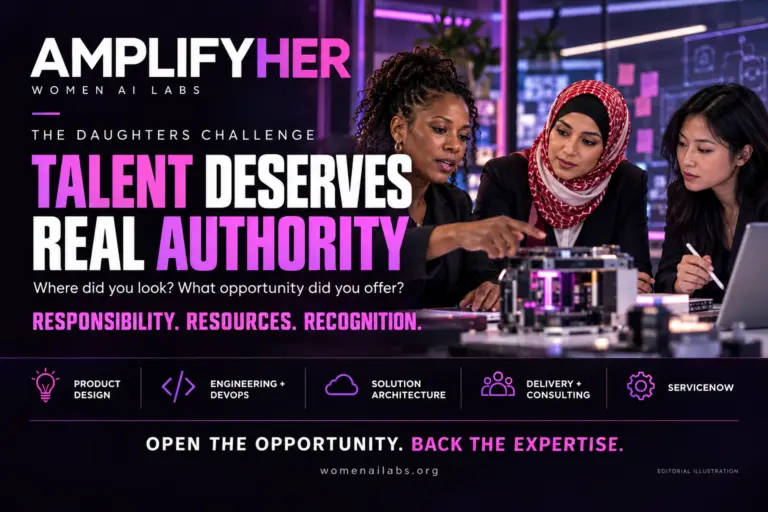
The companies that have benefited from women’s talent, leadership, creativity, and labor have an opportunity to demonstrate what their commitments mean beyond one conference.
Support the students who lost recruiting opportunities. Continue the interviews. Fund scholarships and technical education. Partner with women-led organizations. Pay community educators. Sponsor the smaller gatherings doing meaningful work all year.
And make those investments measurable.
Because the question isn’t whether women will continue building.
We will.
Black women, in particular, have a long history of creating our own tables when we aren’t offered seats.
But I am tired of that resilience being used as an excuse not to invest in us.
Our ability to build without support should never become the justification for withholding it.
The question is why we are still expected to build the tables, provide the chairs, prepare the programming, invite the guests, and then convince someone that the gathering is worth funding.
We’ve been telling y’all.
The quiet part isn’t quiet anymore.
And perhaps the most important question isn’t whether women belong in the future of technology.
It’s whether the institutions benefiting from our contributions are willing to invest in that future with us.
Because if the answer is yes, it’s time to show us the budget.
About the Author
Brée Nachelle Hill is the founder of BN Innovations, an AI educator, creative strategist, and author of Aligned, Not Automated. She serves as Strategic Advisor, Narrative & Community Impact for Women AI Labs and co-leads the Early Stage Track for DC Startup & Tech Week 2026. Through Build in Beta and Synergy Squad, she creates spaces where emerging technologies, community, and human-centered innovation meet.
Sources and further reading
- AnitaB.org — An Important Update About Grace Hopper Celebration. Official cancellation announcement and financial explanation.
- Mary Ann Azevedo, Crunchbase News — Venture Dollars for Black Startup Founders Stay Scarce Despite AI Funding Boom. May 28, 2026.
- U.S. Bureau of Labor Statistics — Women in the Labor Force, 2024. Occupational employment by sex.
- Sandy Carter, Forbes — For Women in AI, What the Grace Hopper Celebration Cancellation Means. October 13, 2026.
This article is an opinion editorial. Its interpretation of industry funding priorities reflects the author’s perspective and should not be understood as evidence of the motivations of individual sponsors or attendees. The author’s accounts of her own community-building work are first-person testimony.


Leave a Reply