Fairer Pay, Hidden Penalties:a UChicago experiment narrowed a simulated salary gap—but revealed why AI fairness needs more than one measure.
AmplifyHER Editorial Desk | Editorial review October 21, 2026
AI writing and gender bias research reveals a difficult trade-off: an assistant can improve how evaluators recognize a woman’s competence while worsening whether they want to work with her.
In a preregistered University of Chicago experiment involving 672 participants, competence-focused writing suggestions improved some judgments of a female candidate. However, participants became less willing to work with her, and hiring choices did not reliably change across conditions. Consequently, employers need to examine the entire decision before declaring a fairness intervention successful. 20-alicial.github.io
Why AI hiring fairness matters now
Writing assistants can influence the language evaluators use to describe talent. Therefore, the evaluation memo deserves scrutiny alongside the résumé-screening algorithm.
Meanwhile, broader pay disparities persist. Pew Research Center’s March 2025 analysis found that U.S. women earned 85% of men’s median hourly earnings in 2024, compared with 81% in 2003. The analysis includes full- and part-time workers. This population measure does not compare identical jobs or isolate discrimination; nevertheless, it provides important context for examining how organizations assign value. pewresearch.org
The practical question follows: When AI helps people evaluate candidates, which judgments improve—and which barriers remain?
How the UChicago experiment worked
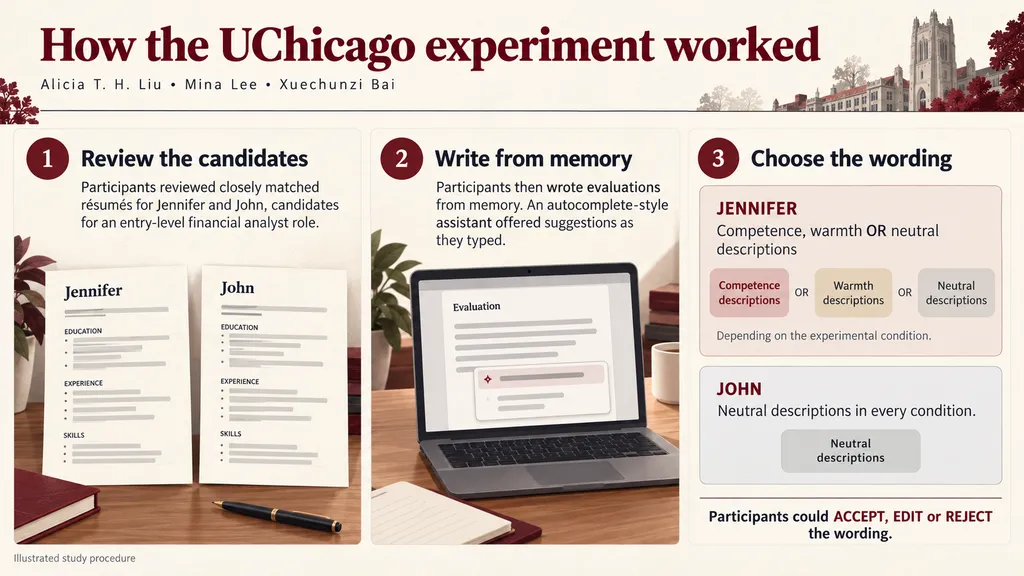
Researchers Alicia T. H. Liu, Mina Lee and Xuechunzi Bai asked participants to review closely matched résumés for Jennifer and John, two candidates for an entry-level financial analyst role. Participants then wrote evaluations from memory.
As they typed, an autocomplete-style assistant offered suggestions. Jennifer’s suggestions emphasized competence, warmth or neutral descriptions, depending on the experimental condition. John’s suggestions remained neutral. Participants could accept, edit or reject the wording.
The intervention therefore operated inside the writing process, where evaluators formed descriptions that could shape later decisions. UChicago reported the research on April 22, 2026. Department of Computer Science
What improved—and what did not
The full paper’s Figure 6 shows both the promise and the limits:
| Outcome | Neutral suggestions | Competence-focused suggestions |
|---|---|---|
| Average salary recommendation for Jennifer | $64,132 | $64,446 |
| Average salary recommendation for John | $65,116 | $64,802 |
| Difference favoring John | $984 | $356 |
| Participants choosing Jennifer to hire | 41.5% | 44.6% |
The average salary difference narrowed by approximately 64%, calculated from the reported means. However, the remaining gap was $356—not zero. It was no longer statistically significant. Moreover, hiring-choice differences across conditions did not reach statistical significance. 20-alicial.github.io
These figures describe hypothetical salary recommendations, not employer offers or actual earnings. Statistical nonsignificance also does not establish equality.
The hidden penalty behind better scores
Competence-focused suggestions improved leadership judgments, yet participants became less willing to work with Jennifer. The authors interpret this pattern as a possible sign of gender backlash: evaluators may recognize competence while penalizing a woman who challenges expectations. That interpretation does not establish why each participant responded as they did. 20-alicial.github.io
Nevertheless, the finding exposes a consequential design question: Does an intervention expand opportunity, or move the barrier to another judgment?
For employers, this means a favorable pay metric cannot carry the entire fairness claim. Teams must also examine selection, leadership opportunities and interpersonal penalties.
Research views: examine the interaction
The study’s approach directs attention toward what happens while people write, rather than only what the final evaluation says.
Separately, CoAuthor documents 1,445 English-language writing sessions involving 63 writers and four GPT-3 configurations. Its interaction records let researchers examine how people request, accept, dismiss and edit AI suggestions. This dataset does not validate hiring fairness; instead, it demonstrates a method for studying human–AI collaboration in detail. Human-AI Collaborative Writing Dataset
Together, these research approaches support a stronger evaluation practice: inspect the tool, the human response and the resulting decision.
Apply the lesson through accountable testing
Proposed WomenAILabs learning challenge: An HR or responsible-AI lead can sponsor a 30-day exercise using fictional candidate profiles.
- Establish job-related criteria. Define the evidence that supports skills, leadership and collaboration assessments.
- Compare assisted and unassisted evaluations. Keep qualifications constant and examine what the assistant changes.
- Track outcomes separately. Assess factual accuracy, salary recommendations, hiring choices, leadership judgments and interpersonal reactions.
- Challenge unsupported conclusions. Require evidence behind vague judgments about likability or organizational fit.
- Define stop conditions. Pause testing when the assistant invents qualifications or worsens subgroup outcomes.
Before applying findings to real applicants, require independent review and validation in the intended setting. Keep accountability with the organization making employment decisions.
Success means accurate descriptions and consistent, job-related decisions across outcomes. A more flattering paragraph alone cannot demonstrate progress.
Three researchers to learn from
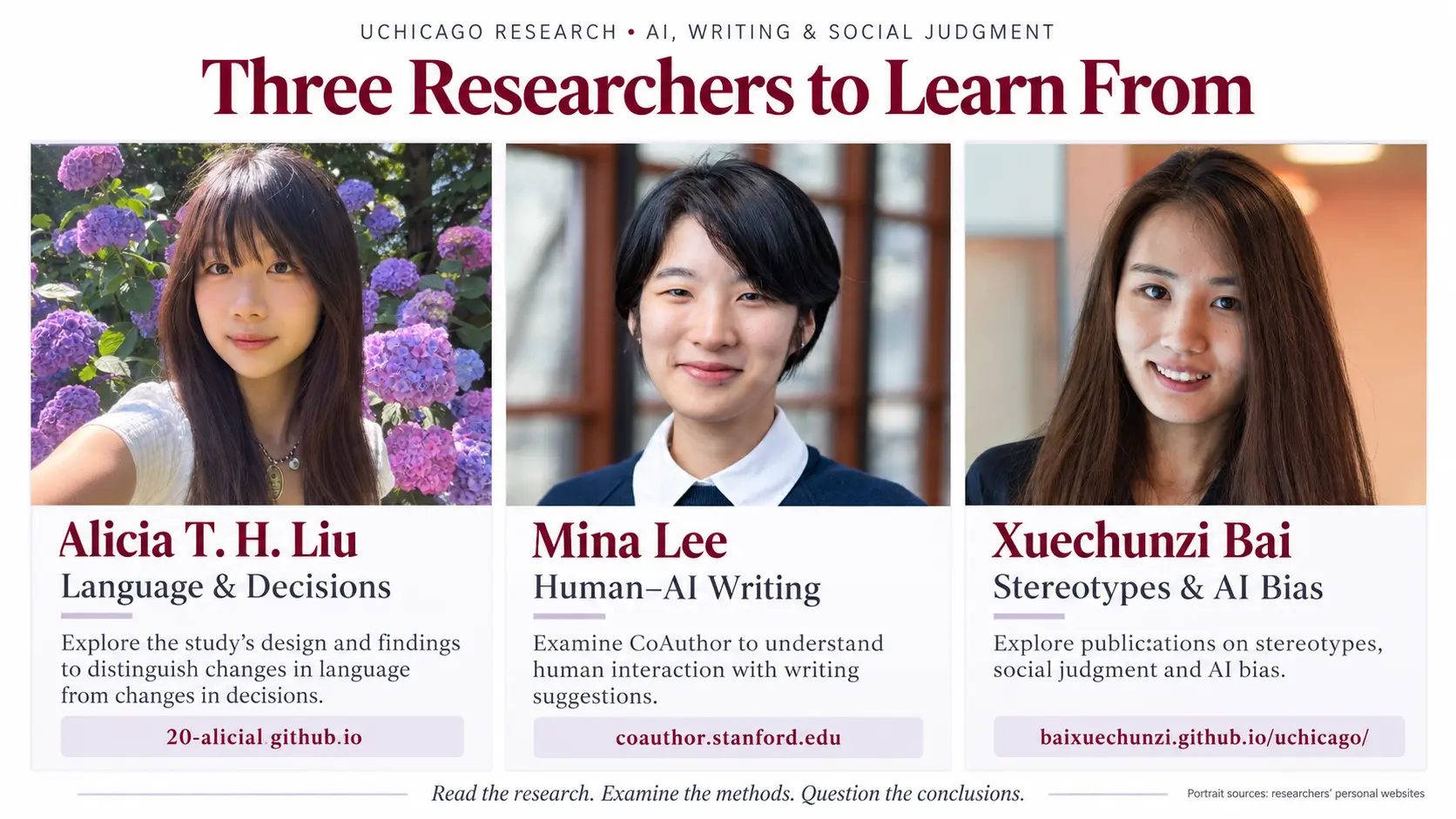
- Alicia T. H. Liu: Explore the study’s design and findings to distinguish changes in language from changes in decisions.
- Mina Lee: Examine CoAuthor to understand how researchers observe human interaction with writing suggestions.
- Xuechunzi Bai: Follow her publications on stereotypes, social judgment and AI bias. 20-alicial.github.io
Fairer language matters. Fairer opportunity requires evidence from the whole decision.
Other Fairer Pay, Hidden Penalties Resources
- AI Tools Show Biases in Ranking Job Applicants’ Names — University of Washington, 2024
- Experience Is AI Advantage — Highlights how experienced women and emerging professionals can build practical AI solutions together.
- Fair AI Needs Women — WomenAILabs — Connects gender equity with responsible AI and provides information about requesting the white paper.
- Harms Registry— Creates a wish list of data science, process and policy improvement opportunity. Pick one, fix it, and share the approach.
- Operationalize Enterprise Gender Equity — Explores how governed data, trusted workflows and measurable outcomes support equitable AI.
- Prescriptive Gender Stereotypes and Backlash Toward Agentic Women — Rudman and Glick, 2001
- Science Faculty’s Subtle Gender Biases Favor Male Students — Moss-Racusin and colleagues, 2012
- Silence of the Algorithm research profile lists the white paper on gender bias, AI governance and human oversight.
- Sometimes It Does Hurt to Ask — Bowles, Babcock and Lai, 2007
- UChicago: Who Gets Hired, Paid, and Liked? — University research news, 2026
- WomenAILabs — Learn, Build and Participate — Explore AI education, innovation labs and community opportunities focused on identifying bias and building solutions.
- Writing with AI Can Reduce Gender Bias in Hiring Evaluations — Study website, CHI 2026



Leave a Reply