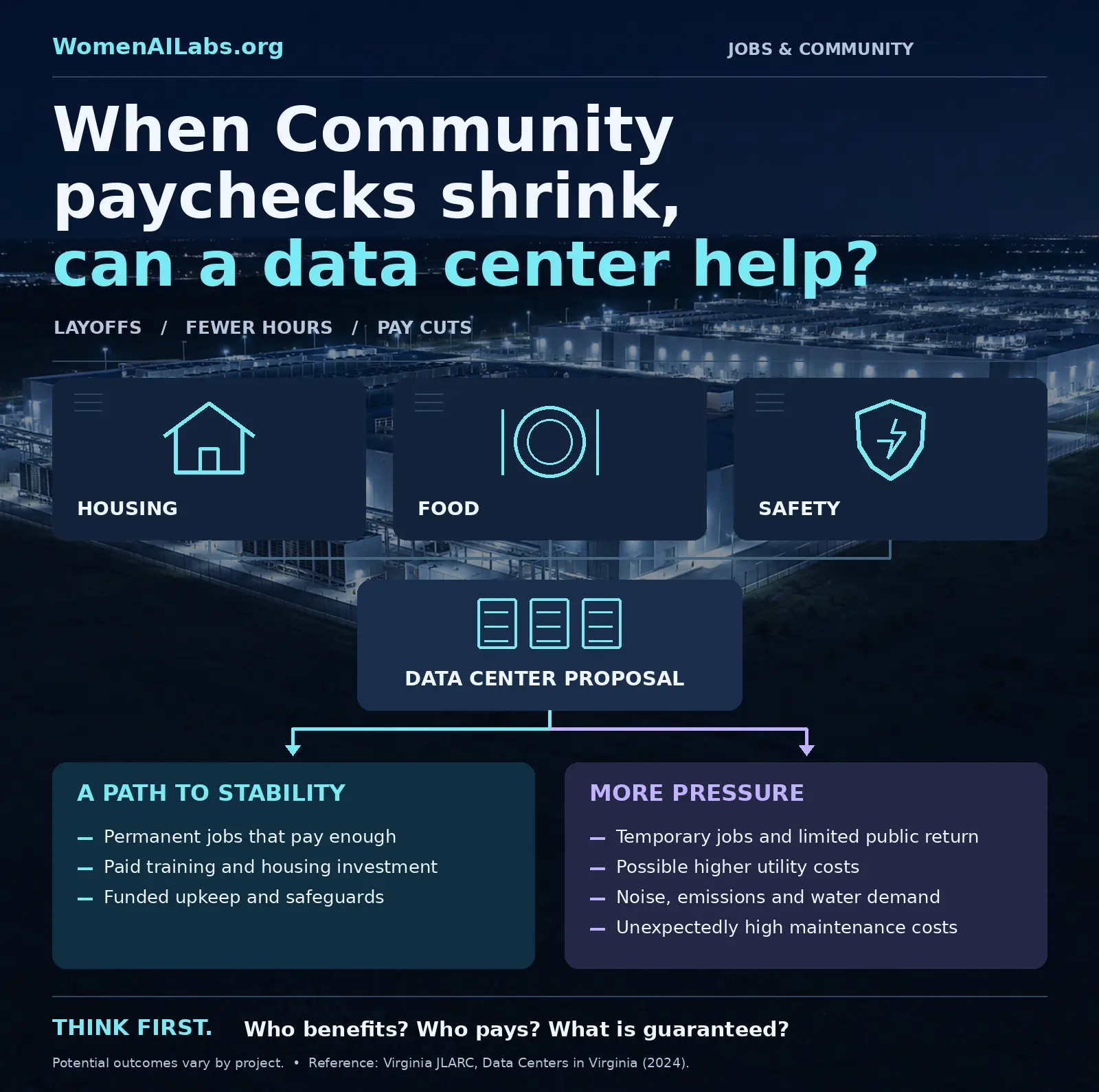
As data centers attract billions in investment, families and communities deserve a clear answer. Who gains jobs and revenue? Who may face higher costs or environmental burdens? And what should developers do to make sure the people living nearby share in the benefits?
Prince George’s Sierra Club, MD honors Taylor Frazier McCollum Environmental Service Activism
In Prince George’s County, Maryland, Taylor Frazier McCollum helped bring those questions to the forefront. Her leadership also points to a larger challenge: connecting AI investment to secure livelihoods, accountable infrastructure and communities where families can thrive.
A Mother Who Organized a County
Taylor Frazier McCollum
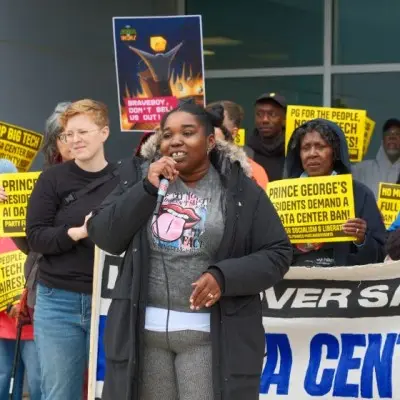
We read with interest NPR’s story, reported by WAMU’s Jenny Abamu, about Taylor Frazier McCollum, a Maryland mother whose concern for her community grew into a campaign challenging a proposed $5 billion data center campus at the former Landover Mall. The site is nearly 90 acres of empty land in a predominantly Black community, and county planners approved the project in 2024.
McCollum helped organize residents, spoke to decision-makers and launched a petition that has gathered about 23,000 signatures. In September 2025, the county executive paused data center development and created a task force. That pause is a significant moment for community participation, although it does not mean the proposal has been permanently canceled.
The campaign carried a personal cost. NPR reports that McCollum has lost jobs to show up at county hearings and knock on doors. WAMU also reported that she and her daughter lost their apartment after her employer reduced her wages. The reporting does not establish that AI caused that reduction.
Where that reporting leaves off, Women AI Labs wants to continue the conversation. McCollum’s leadership reaches beyond one project. How can someone who shows that much initiative gain the opportunity to build financial stability for her own family? More broadly, how can communities realize growth that builds community? Where must AI development improve life for the people living beside it, working around it and paying into the systems that support it?
Behind AI Investment, Families Need Breathing Room
McCollum’s experience illuminates a broader financial challenge.
In a Census Bureau survey conducted July 15 through August 3, 2026, approximately 52.2 million U.S. adults reported difficulty paying usual household expenses during the previous two months. Within that total, approximately 8.5 million adults lived in households that had recently lost employment income and also struggled with expenses. These are weighted estimates from the experimental Household Trends and Outlook Pulse Survey. Those figures count adults, not unique families, and do not identify AI as the cause.
For a family-level view, Census tables released in 2026 show that approximately 2.57 million families with a female householder, no spouse present and related children under 18 lived below the official poverty line in 2025. That represented 29.5% of that family category, which is broader than “single mothers.”
Together with the NPR reporting, these statistics show why economic development must address household stability as well as investment in data centers, which may not be a quick win. McCollum turned community concern into action. Her leadership deserves a pathway to new opportunities, lasting change and support for her family.
Taylor Frazier McCollum is looking now for Community Organizer Roles in her area. In the meantime, a GoFundMe is stood up go fund me account, until she lands her next opportunity at https://sms.gf.me/B3DOmwh1
Who Benefits From AI Data Centers?
Data centers can create construction work, operating jobs, supplier contracts and tax revenue. Technology companies, investors, landowners and infrastructure providers may benefit. Communities may also gain employment and revenue for public services.
The size and distribution of those benefits depend on the project. A multibillion-dollar headline does not tell residents how many permanent jobs will exist, what they will pay or how much public money will support the development. Local leaders should publish:
- Permanent positions, separately from temporary construction jobs.
- Pay ranges, benefits, schedules and qualifications.
- Local hiring commitments and paid paths into funded openings.
- Projected public revenue after incentives and public costs.
- Progress reports showing what was promised and what was delivered.
Household arithmetic matters
The MIT Living Wage Calculator estimates that one adult supporting one child in Prince George’s County needs $44.05 an hour, or approximately $91,617 before taxes annually, to cover modeled basic needs while working full time. That is an estimate for one household type, not a legal wage requirement or a description of every family. It does illustrate the difference between creating a job and creating a livelihood.
Who Should Bear the Data Center Maintenance Costs?
The strongest evidence about costs is regional. PJM, the grid operator serving Maryland and 12 other states plus Washington, D.C., sets capacity prices that flow into household electric bills. PJM’s independent market monitor describes data center load growth as the primary reason for recent and expected capacity market conditions. An IEEFA analysis of the monitor’s work estimates that data centers were responsible for 63% of the price increase in the 2025/2026 auction, about $9.3 billion recovered from customers across the region. Maryland’s People’s Counsel notes that hardly any of the data centers driving those costs are located in Maryland. A Prince George’s household can help pay for data centers it never hosts.
Lower-income households feel bill increases most. The Department of Energy treats an energy burden above 6% of income as high, and Energy Central reports that households earning 30% or less of area median income face burdens of 10% to 20% in data-center counties it reviewed.
A data gap we want to name: we found no published measurement of these cost effects on single-mother households. The concern rests on low-income energy burden data, not a direct measurement of that group.
Nearby residents may also experience data center construction disruption, noise and other burdens. Chicago offers a local example. A city working group documented noise complaints through the 311 system and gaps in facility-level water reporting, and ComEd cited growing data-center demand among several factors in a residential increase. Meanwhile, workers may find it hard to enter training or accept jobs without reliable childcare, transportation or predictable hours.
What should we call progress when a project adds costs and burdens for neighbors without creating secure income for them? These are potential effects, not proof that a particular facility will cause them. Communities need project-specific evidence, independent review and enforceable safeguards before drawing conclusions.
If You Build It, Who Must Sustain It?
The infrastructure demands deserve scrutiny. The International Energy Agency’s 2026 outlook projects global electricity consumption by data centers rising from 485 terawatt-hours in 2025 to approximately 950 in 2030. Those figures cover all data centers, not AI alone. The projection makes local planning essential, and it does not establish harm from every individual facility.
Earthjustice’s analysis adds a risk worth asking about early: if a large data center ramps up slowly, curtails its load or closes, the costs incurred to support it can shift to the rest of the customer base. Communities should ask:
- Who pays for new electricity and water infrastructure?
- What happens if a project closes before those costs are recovered?
- How will operators measure water use, noise and emissions?
- Who investigates complaints, and what remedy follows?
- How will residents know whether promised benefits actually arrive?
Better Data-Center Practices Can Start Now
Communities do not have to begin with a blank page. Examples already show approaches worth examining, although each needs transparent local oversight.
In January 2026, Microsoft announced its Community-First AI Infrastructure initiative. Its commitments include covering electricity costs its facilities create, reducing water use, supporting local employment and contributing to community services. Microsoft also describes work in Quincy, Washington, to treat and recirculate cooling water. This is a company-reported example, not independent proof that every commitment has been fulfilled.
Loudoun County, Virginia, describes requirements for data-center noise studies before and after construction, a residential property-line limit and enforcement. Its guidance also explains the limits of its current rules, including that they do not specifically regulate tonal or low-frequency noise.
Virginia’s data-center tax incentive provides another accountability example. It generally ties eligibility to job, wage and reporting requirements, with repayment provisions when performance targets are missed. Different thresholds can apply in distressed localities.
These examples are starting points. They do not mean every community is protected or every promise has been fulfilled.
What a Credible Project Delivers
A credible project turns intentions into specific, measurable commitments, enforced through permits, utility proceedings, contracts and community agreements. The U.S. Department of Energy’s community benefits agreement guidance offers resources for making commitments measurable and giving communities a continuing role. The right agreement and enforcement tools depend on the project and local law.
Who Bears the Cost of AI Growth?
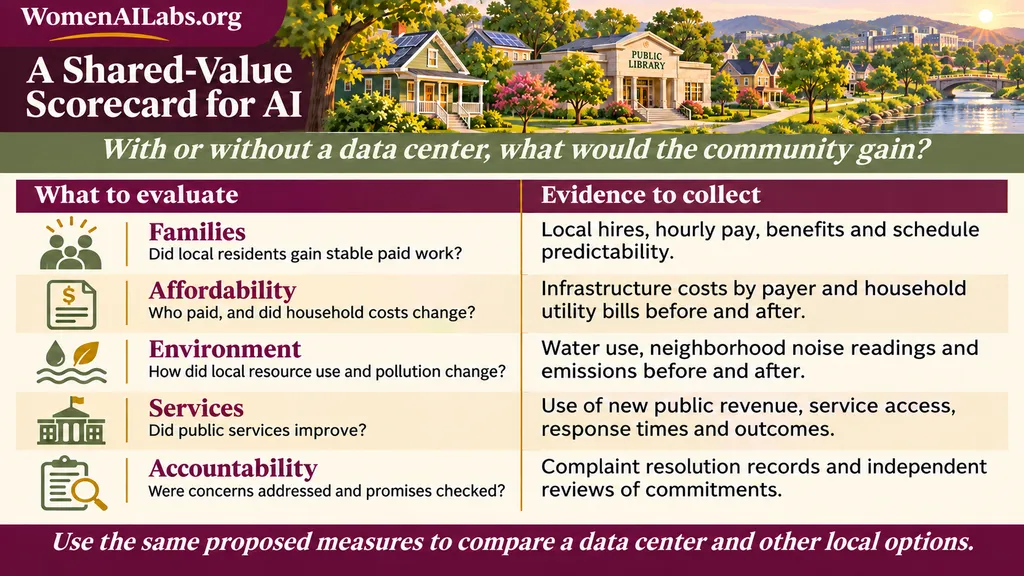
Data centers can bring investment and opportunity. However, their benefits and burdens may not reach the same people. This matrix separates documented evidence from risks communities should investigate.
| Equity issue | Who may be affected | Evidence and references | Action or protection |
|---|---|---|---|
| Household energy costs | Residential customers, especially households with lower incomes | The Department of Energy reports a higher average home-energy burden for low-income households. PJM’s independent market monitor estimates that data-center demand increased regional wholesale capacity-auction revenues. These are not AI-only household-bill figures. | Review local cost allocation and affordability before and after a project connects. |
| Stranded infrastructure | Utility customers who could face costs if demand falls short | Virginia’s independent audit identifies the risk. Ohio regulators have approved minimum-payment and certain cancellation protections. | Require appropriate cost allocation, financial security and exit protections. |
| Unpaid civic labor | Residents balancing participation with paid work, caregiving and other responsibilities | Oregon’s engagement guidance identifies unpaid time as a barrier. The Urban Institute offers a compensation framework. | Pay residents for their time and reduce childcare, transportation and scheduling barriers. |
| Meaningful public participation | Residents affected by siting decisions | The Landover hearing record confirms a 2024 hearing; residents later reported feeling blindsided in their petition. | Provide early, accessible notice, understandable information and a genuine opportunity to influence decisions. |
The test: Who receives the benefits, who carries the costs and who has a meaningful voice?
The question is not only whether a project creates value. It is who receives the benefits, who carries the costs and who has a meaningful voice in the decision.
Illinois: Why Local Impact Evidence Matters
Illinois offers examples of concerns that require specific answers.
Chicago’s Sustainable Data Centers Working Group report discusses noise complaints recorded through the city’s 311 system and facilities’ use of municipal drinking water. It also identifies gaps in facility-level water reporting.
In suburban Aurora, ABC7 reported residents’ noise concerns and the operator’s acknowledgment and mitigation efforts. The response warrants measurement and follow-through, with no assumption that every concern has been resolved.
Electricity costs also require careful attribution. ComEd explained an estimated average monthly residential increase of $10.60 beginning in June 2025 through several regional capacity-market factors, including growing data-center demand. That estimate was not a data-center-only surcharge or every household’s actual increase.
These examples support scrutiny of affordability and neighborhood impacts.
A Pathway for Residents Like Taylor
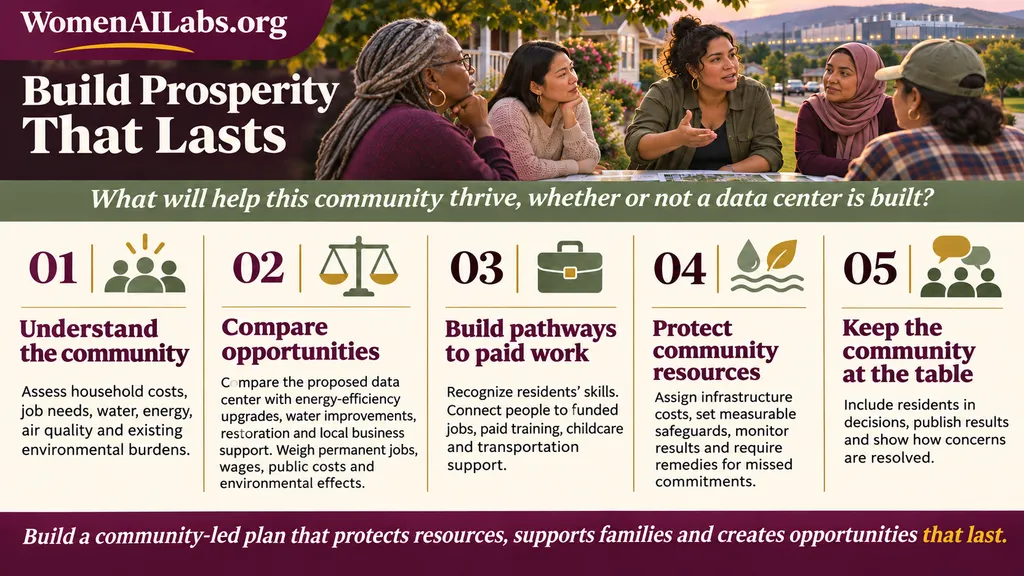
The goal: pay people for their knowledge, protect their voice and create opportunities that sustain families, with or without a data center.
1. Turn Experience Into Paid Work
| Action | Lead | Measure |
|---|---|---|
| Pay residents for outreach, facilitation and local knowledge | Community organizations | Paid roles and earnings |
| Connect paid training to real jobs in fields with local demand | Employers and training partners | Placements and retention |
| Help participants access childcare, transportation and predictable schedules | Program and support partners | Participation and family stability |
2. Put Residents in Charge
| Action | Lead | Measure |
|---|---|---|
| Form a resident-majority steering committee and pay members for their time | Residents and fiscal sponsor | Decisions shaped by residents |
| Publish funding, selection rules and results, then address concerns independently | Program administrator | Transparency and concerns resolved |
| Protect participants’ freedom to question any project or funder | Steering committee | Clear, enforceable independence rules |
3. Fund and Prove Lasting Impact
| Action | Lead | Measure |
|---|---|---|
| Secure workforce funding and paid service contracts before recruiting | Fiscal sponsor and partners | Funding and work secured |
| Launch a proposed six-month pilot for 10 to 12 residents | Program and employers | Paid assignments and job placements |
| Track earnings, retention and community improvements | Residents and evaluation partner | Lasting jobs and measurable results |
How Can AI Data Center Create Value Beyond Construction?
AI can potentially help people do their work, access services and learn. Communities should require evidence that those benefits reach them.
A study of customer-support agents found that access to a generative AI assistant increased the number of issues resolved per hour, with particularly strong gains for less-experienced workers. That does not, by itself, prove workers received higher pay or job security.
In Nigeria, a World Bank-supported tutoring study found learning gains in an after-school program using AI with teacher support. Results in one setting do not guarantee the same outcome everywhere.
A study of AI advice for small businesses in Kenya found no detectable average improvement in revenue or profits and weaker outcomes for some firms. The lesson: access to a tool does not guarantee a proven benefit.
AI County Compass: A Comprehensive Toolkit for Local Governance and Implementation of Artificial Intelligence could create a framework or ideas employers, schools and public agencies to test whether AI helps people find suitable work, learn practical skills or receive services more effectively. Then it should a Data Center project is introduced with proven community benefits, then measure the results, protect privacy, provide human help and offer a way to correct mistakes.
What We Are Recording
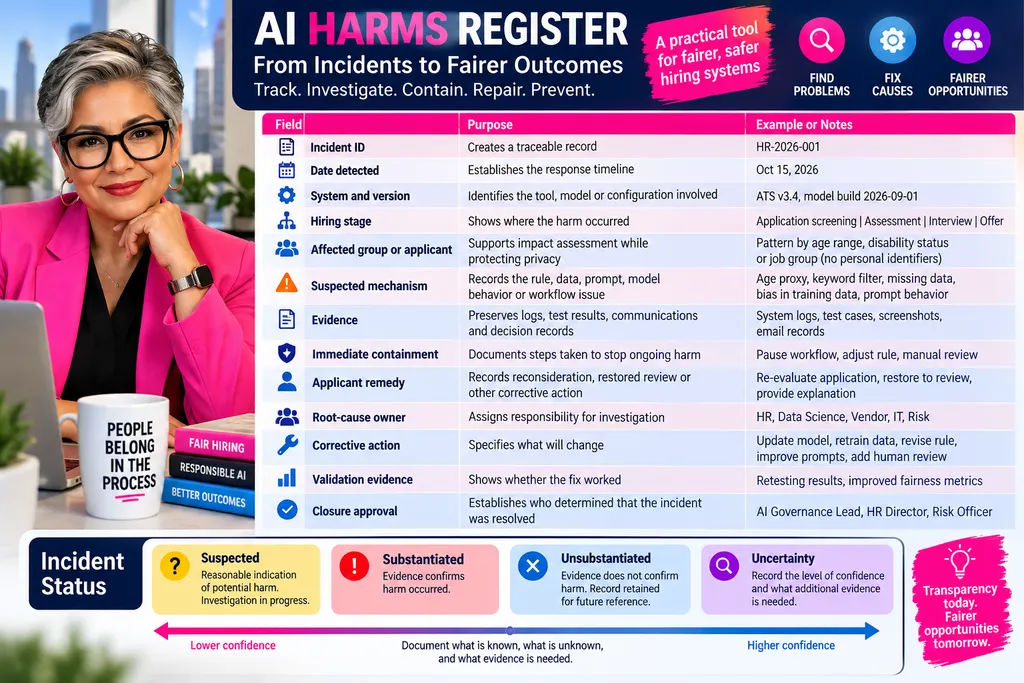
Women AI Labs is logging the following signals in the Equitable AI Harms Register, unscored, with fix status stated plainly:
- Grid costs on household bills. Capacity and transmission charges driven largely by data center demand reach residential customers across the region. No verified fix yet.
- Stranded infrastructure costs. Upgrades built for a facility can shift to other customers if it shrinks or closes. No fix yet.
- Unpaid civic labor. Resident advocates, often caregivers and shift workers, absorb lost wages to scrutinize public decisions. No fix yet.
- Late public notice of siting. Residents learned of the Landover project after it was well advanced. A county pause and task force exist, with no permanent rule found.
AI prosperity should create room for families to thrive, not simply room for more infrastructure.
Amplify the People Building Better Pathways
Your Experience Can Open Doors
You’ve solved problems, supported people and spoken up when something needed to change. What if those experiences could open the door to your next opportunity?
At Women AI Labs, you can connect with people who want to learn, share their expertise and put ideas to work. Explore new skills, bring a problem you care about and join a community working toward solutions that make life better.
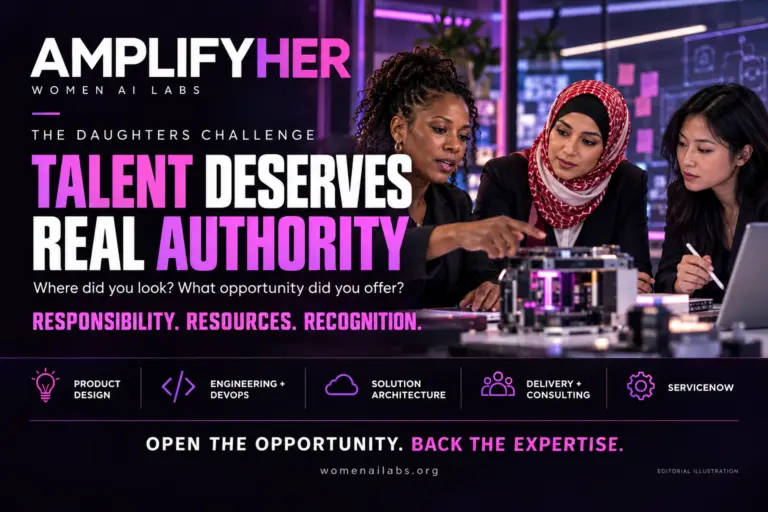
Through AmplifyHER, we celebrate women who lead and advocate for their talents to be recognized in meaningful work and decisions. Your story, your questions and your perspective belong in that conversation.
Bring what you know. Discover what’s possible. Help build what comes next.
Build AI Service Excellence | Equitable AI Harms Register |Get involved | Women AI Newsroom |



Leave a Reply