Building Saudi AI Foundations: Rabab Alomairy’s research reveals how algorithms, software and advanced computing work together to build more capable AI systems.
AmplifyHER Editorial Desk | Editorial review: October 21, 2026
Rabab Alomairy’s AI research tackles a challenge beneath every impressive interface: how can software turn powerful computing hardware into useful performance? In July 2026, King Abdullah University of Science and Technology (KAUST) announced her appointment as its first Saudi woman faculty member in computer science. Her work connects high-performance computing, scalable algorithms and AI infrastructure—making the engineering behind AI more visible. cemse.kaust.edu.sa
For students exploring AI careers, that work opens an important perspective. Building the future requires people who understand how computers calculate, coordinate tasks and move information, alongside those who design applications.
What is hardware-aware AI infrastructure?
AI infrastructure brings together the computing platforms and software that support model training, inference and scientific workloads. Within that foundation, hardware-aware design accounts for the capabilities and constraints of the processors running the work.
Alomairy studies co-design, which develops algorithms, software and computing systems together. Rather than expecting hardware upgrades alone to deliver better results, this approach examines how the entire system handles a calculation. KAUST identifies that connection as a central theme of her research. cemse.kaust.edu.sa
Think of a busy workshop. Different machines handle different jobs, while materials must move between them. Similarly, a computing system must decide where calculations happen, how tasks coordinate and when data moves.
Consequently, better engineering starts with understanding the workload.
A research case: matching precision to computation
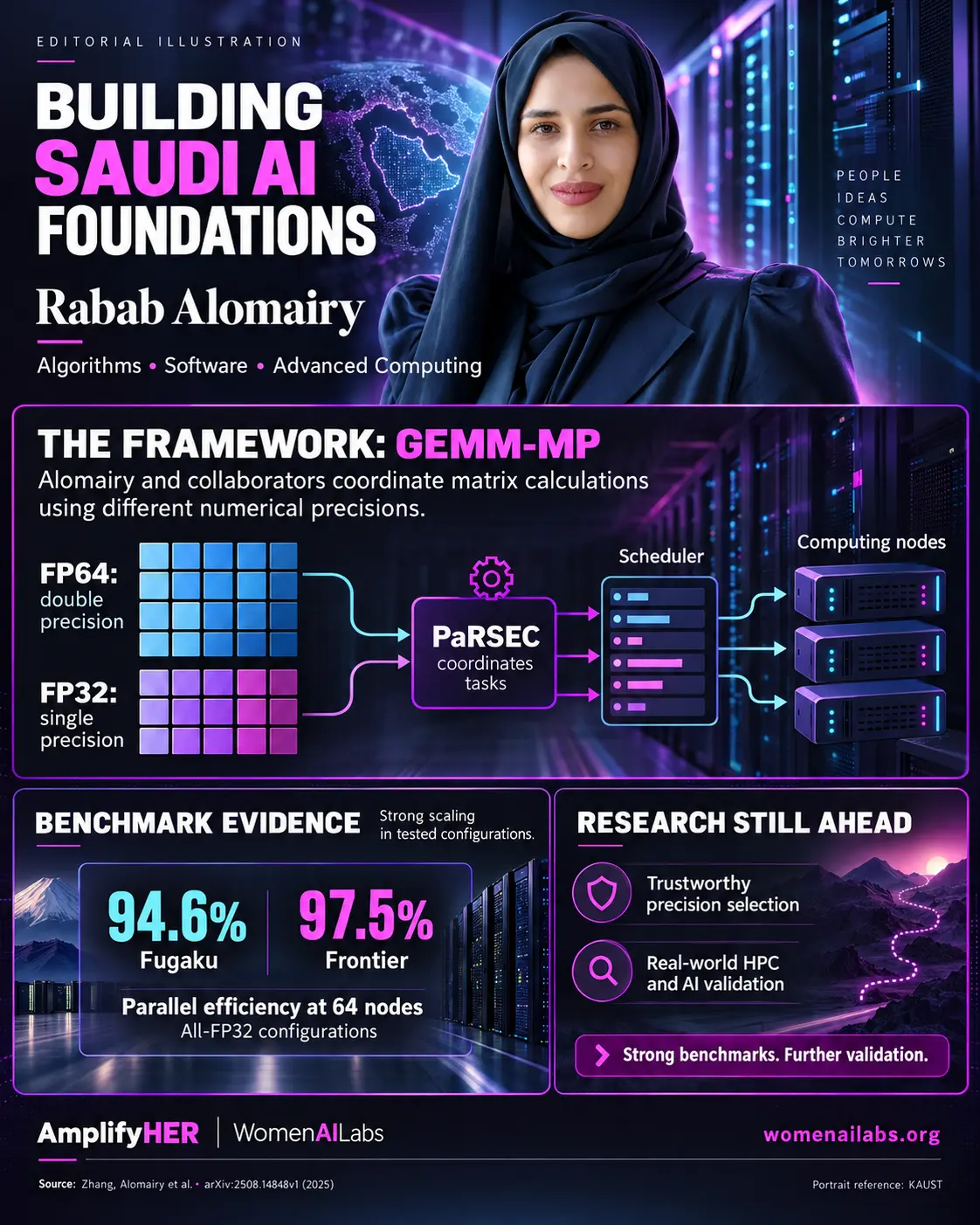
In their August 2025 preprint, Alomairy and colleagues present GEMM-MP, a framework that divides matrix multiplication into smaller blocks, or tiles. The framework supports different numerical precisions across tiles, while the PaRSEC runtime system coordinates computational tasks. Their evaluation examines FP64 double precision and FP32 single precision across several computing platforms. arxiv.org
One result illustrates its ability to scale: the all-FP32 configuration achieved 94.6% parallel efficiency across 64 Fugaku nodes relative to one node. That measures how closely performance approached ideal scaling for that configuration; it does not mean AI became 94.6% faster. arxiv.org
However, the authors identify trustworthy precision selection and deployment in real-world HPC and AI applications as future work. Therefore, the benchmark supports a specific achievement in computational coordination and scaling. Establishing application accuracy, energy savings or production benefits requires further testing. arxiv.org
For enterprise teams, the practical lesson is clear: measure performance against the actual workload, and evaluate accuracy alongside speed.
Alomairy and her collaborators developed a framework for coordinating matrix calculations at different numerical precisions.
Supercomputer benchmarks demonstrated strong scaling, while reliable precision selection and real-world AI benefits remain subjects for further research.
Why Alomairy’s Saudi research leadership matters
After earning her master’s and doctorate at KAUST, Alomairy conducted postdoctoral research at MIT before returning to the university. KAUST’s appointment announcement also describes her plans to establish the Tuwaiq Intelligent Computing Lab and mentor future researchers. Those are announced intentions; the source does not establish subsequent lab outcomes. cemse.kaust.edu.sa
Her story makes technical authority visible in a field that often receives less public attention than AI applications.
Moreover, it gives students a concrete set of subjects to explore: numerical methods, parallel programming, operating systems and performance engineering. These disciplines offer routes into the foundations that determine how effectively AI systems run.
Three researchers to learn from
These selected resources offer complementary learning paths.
- Rabab Alomairy: Examine the tile-centric matrix-multiplication paper. Follow how the researchers define configurations, compare platforms and explain limitations. arxiv.org
- Hatem Ltaief: Explore his coauthored mixed-precision genomics research, which also includes Alomairy. It connects numerical computing with genome-wide association studies. arxiv.org
- Katherine Yelick: Visit her UC Berkeley research resources to study parallel algorithms, communication-avoiding methods and automatic performance tuning. people.eecs.berkeley.edu
Saudi Women Advancing AI
Women in AI in Saudi Arabia draw on a substantial STEM talent pool and an expanding technology workforce. Amplifying their work can connect proven expertise to research funding, paid opportunities and leadership.
The evidence shows a strong foundation:
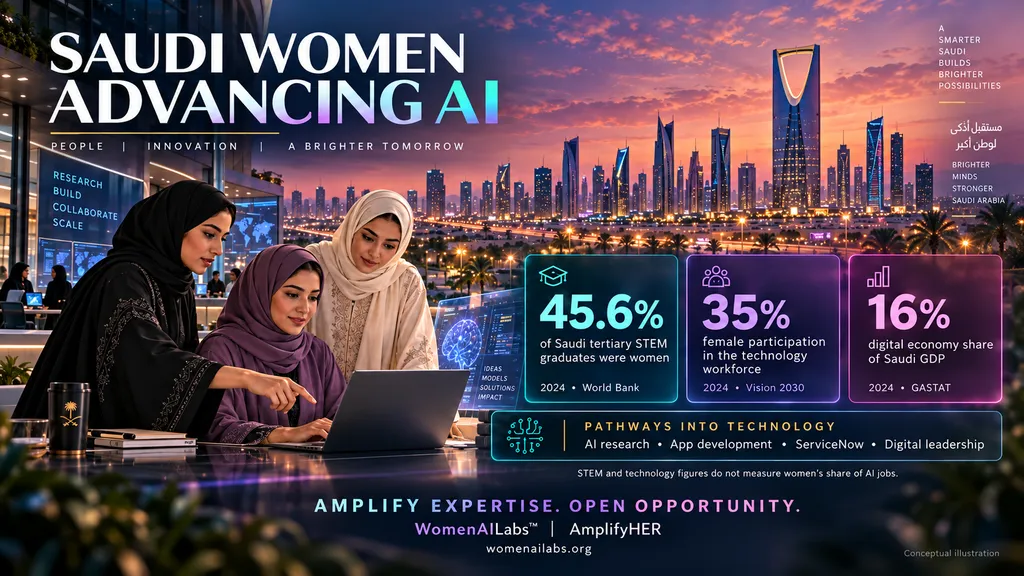
- 45.6% of Saudi Arabia’s tertiary STEM graduates were women in 2024, according to the World Bank. genderdata.worldbank.org
- Women represented 35% of the technology workforce, according to the 2024 Vision 2030 report. This measures technology broadly, rather than AI employment specifically. www.vision2030.gov.sa
- The digital economy contributed 16% of Saudi GDP in 2024, demonstrating the economic importance of digital capabilities. stats.gov.sa
Meanwhile, women are strengthening AI’s foundations. Rabab Alomairy joined KAUST’s computer science faculty in July 2026, advancing research in high-performance computing, scalable algorithms and AI infrastructure. In Riyadh, 192 women completed the Apple Developer Academy’s fifth cohort in 2026, developing technical, design and professional skills. cemse.kaust.edu.sa
Furthermore, Saudi-backed initiatives are widening learning pathways. ICAIRE and Microsoft’s 2025 Elevate cohort targeted 5,000 women internationally—a training target, rather than a count of Saudi women employed in AI. www.spa.gov.sa
ServiceNow adds an enterprise technology pathway. SDAIA Academy lists an 11-week ServiceNow bootcamp, while ServiceNow University offers Arabic learning content. However, the reviewed sources do not establish how many women work in Saudi Arabia’s ServiceNow ecosystem or hold its certifications. sdaia.gov.sa
Therefore, the next step is to connect learning and visibility to responsibility. WomenAILabs and AmplifyHER can spotlight verified contributions, organize mentoring and study groups, and connect women to supervised projects, funded research and paid assignments.
Amplify the expertise. Fund the opportunity. Measure the advancement.
Turn research into student practice
Proposed WomenAILabs learning challenge: Within two weeks, an educator or study-group lead can guide students through a small, reproducible precision experiment using synthetic data.
First, run the same matrix calculation at two numerical precisions. Record the hardware, software version, input size, runtime and error against a higher-precision reference.
Next, repeat each run and change one condition, such as matrix size. Then examine whether the apparent advantage survives.
Finally, publish a short comparison containing the code, test conditions, runtime results, numerical error and limitations. Measure completion by whether another learner can reproduce and explain the findings. This exercise introduces experimental discipline; it does not replicate the supercomputer benchmark.
Make women’s technical authority visible where AI’s foundations are built. Then give the next generation opportunities to build alongside them.
Explore Women AI Labs, AmplifyHER News, Innovation Labs and ways to get involved. Connect on LinkedIn or explore the AI Harms Registry.




Leave a Reply